
The wall above your bed gets looked at more than almost any other spot in your home. You see it first thing in the morning and last thing before you fall asleep. Yet it’s usually the wall that gets decorated last — or not at all.
Part of the problem is that above bed wall decor feels deceptively simple until you actually try to do it. Hang something too small, and it looks like it’s floating, disconnected from the bed. Hang something too big, and the whole room suddenly feels heavy and off-balance.
This guide walks through exactly how to size, place, and style decor above your bed — plus specific product categories to shop by style and budget. By the end, you’ll know what to buy, how big it should be, and exactly how high to hang it.
How to Choose the Right Size for Above Bed Wall Decor

Size is where most above-bed decor goes wrong. Get this part right first, and almost any style choice will look intentional.
The Width Rule: 2/3 to 3/4 of Your Bed or Headboard Width
IDEA: Your wall decor — whether it’s one piece or a whole gallery wall — should span roughly two-thirds to three-quarters of the width of your bed or headboard.
WHY: This is a proportion trick, not a random guideline. When art is too narrow, your eye reads a gap between the art and the edges of the bed, and the piece looks stranded on a big wall. When art is wider than the bed itself, the bed can start to look undersized by comparison. The two-thirds to three-quarters range is the sweet spot where the art visually “belongs” to the bed.
HOW: Measure the width of your headboard (or the mattress itself if you don’t have one). Multiply that number by 0.65 and by 0.75 to get your target range. If you’re using a set of pieces, add up their combined width, including the gaps between them.
PRODUCT: For a queen bed, this typically points you toward a single large canvas print, an oversized framed print, or a two-to-three-piece canvas or metal art set. Check the product on Amazon.
TIP: When you’re between two sizes, size up. Undersized art is the single most common above-bed styling mistake, and it’s much more noticeable than art that’s slightly generous.
Sizing Chart by Bed Size
Use this as a starting range, not an exact science. A few inches either way won’t make or break the room.
| Bed Size | Approx. Bed/Headboard Width | Target Art Width (65–75%) |
|---|---|---|
| Twin | 39 in | 25–29 in |
| Full/Double | 54 in | 35–40 in |
| Queen | 60 in | 39–45 in |
| King | 76 in | 49–57 in |
TIP: If your calculated width feels awkward for a single piece (like the king range above), that’s your cue to switch to a set of two or three smaller pieces instead of hunting for one oversized print.
How High to Hang Art Above a Headboard
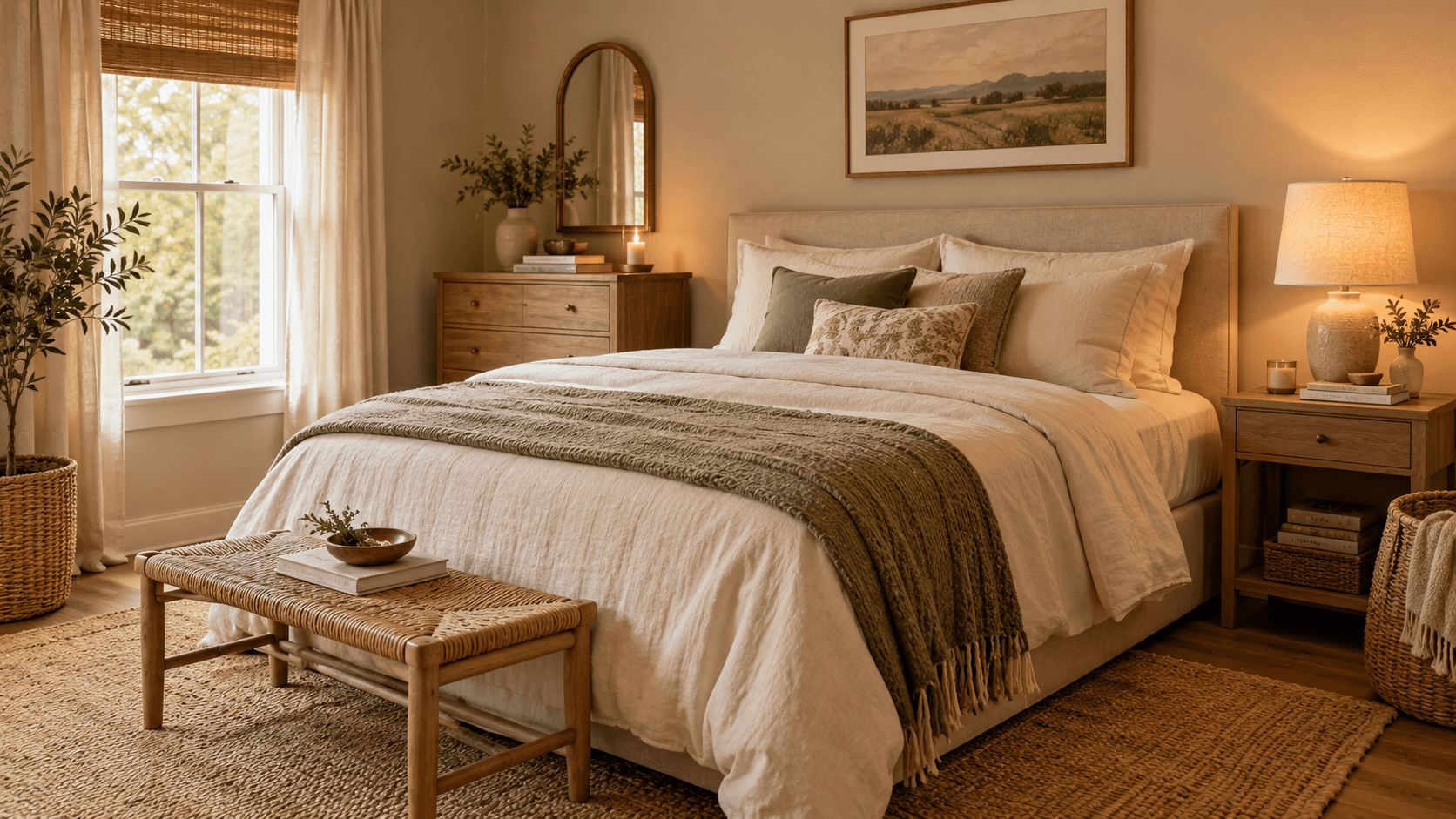
IDEA: Leave a gap of about 6 to 10 inches between the top of your headboard and the bottom edge of your art.
WHY: This gap keeps the art visually connected to the bed instead of looking like it’s randomly placed on the wall. Too little space and it looks cramped against the headboard; too much space and it disconnects from the bed entirely and starts competing with the ceiling.
HOW: Measure from the top of your headboard up 6 to 10 inches, mark that point, and hang the bottom edge of your art there. If you don’t have a headboard, center the artwork so its middle sits around 57 to 60 inches from the floor — the standard eye-level height used in most rooms.
TIP: Tape a large sheet of butcher paper or newspaper cut to the size of your art and stick it to the wall first. Live with it for a day before you commit to a nail hole.
Sizing for a Gallery Wall vs. a Single Statement Piece
IDEA: A gallery wall follows the same width math as a single piece — the total footprint, including gaps, still needs to land in that 65–75% range.
WHY: People often forget to count the spacing between frames when sizing a gallery wall, which is how galleries end up looking too small for the wall even though each individual frame seemed like a reasonable size.
HOW: Lay your frames out on the floor first, spaced 2 to 3 inches apart, and measure the total width and height of the whole arrangement before you hang anything. Adjust frame count or size until the total footprint hits your target range.
PRODUCT: Pre-matched gallery wall frame sets take the guesswork out of spacing and frame-style consistency, which is especially helpful if this is your first time building one. Check the product on Amazon.
Above Bed Wall Decor Styles to Match Your Bedroom

Once size is locked in, style is where you can actually have fun. Here’s how to think through the most common directions.
Boho and Global-Inspired
IDEA: Woven textures, warm neutrals, and asymmetry — think macramé, rattan, and hand-drawn line art.
WHY: Boho above-bed decor works especially well in bedrooms that already lean toward layered textiles, like a chunky knit throw or a jute rug, because the wall decor extends a texture story that’s already in the room.
HOW: Pair one larger woven or macramé piece with a smaller framed print or two off to one side, rather than mirroring everything perfectly. Boho styling leans into slight imperfection.
PRODUCT: A large macramé wall hanging as the anchor piece, with a smaller botanical or line-art print layered beside it. Check the product on Amazon.
TIP: Don’t over-layer. One woven anchor piece plus one or two supporting prints reads as intentional; five different textures at once reads as cluttered.
Modern and Minimalist
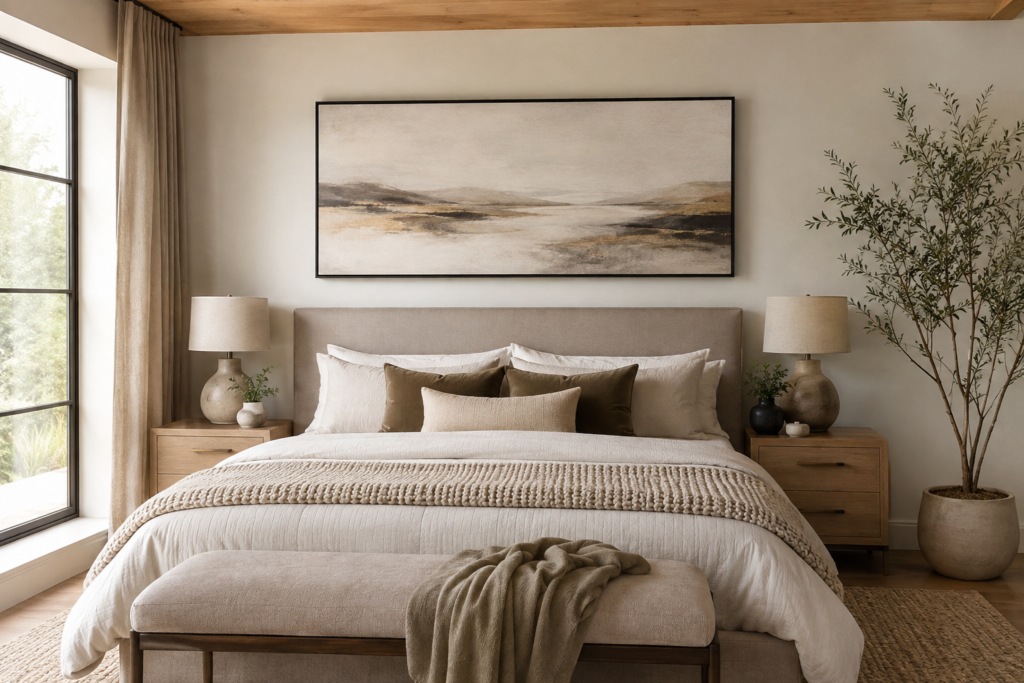
IDEA: Clean lines, a limited color palette, and negative space are the whole point.
WHY: In a modern bedroom, the wall decor is meant to be a quiet focal point, not competing visual noise. A single oversized abstract piece does more for the room than five small ones.
HOW: Choose one large-format piece in a horizontal orientation, and keep the color palette to two or three tones that echo your bedding or wall color.
PRODUCT: A single large abstract canvas or a minimalist line-art print in a slim black or wood frame. Check the product on Amazon.
TIP: Resist the urge to add a second piece “just in case it looks empty.” In minimalist styling, the empty space around the art is doing real design work.
Farmhouse and Rustic
IDEA: Warm wood tones, distressed finishes, and sometimes a short phrase or sign as the centerpiece.
WHY: Farmhouse above-bed decor tends to lean cozy and personal, which is why sign-style art (a short phrase, a family name, a simple saying) is so common in this category — it adds a lived-in, personal feel that pure abstract art doesn’t.
HOW: Look for a single wide piece in natural wood, distressed wood-look frame, or wrought iron, sized to that 65–75% width range so it doesn’t get lost against a large farmhouse-style plank or shiplap wall.
PRODUCT: A large wood-framed sign or wood medallion set in a natural or whitewashed finish. Check the product on Amazon.
TIP: If your bedroom wall is already textured (shiplap, board-and-batten), keep the art frame simple so it doesn’t compete with the wall itself.
Coastal and Neutral
IDEA: Soft blues, sandy neutrals, and horizon-line compositions like ocean views or abstract wave shapes.
WHY: Coastal above-bed art tends to read as calming rather than decorative, which fits the “bedroom as retreat” goal most people are actually going for.
HOW: A long horizontal piece works especially well here because it echoes a literal horizon line, and horizontal orientation naturally suits the wide, low wall space typical above a bed.
PRODUCT: A long horizontal canvas print in a coastal or landscape palette, sized for queen or king headboard width. Check the product on Amazon.
TIP: Stick to two or three colors max — coastal styling loses its calming effect fast if the palette gets busy.
Vintage and Eclectic Gallery
IDEA: A mixed gallery wall of framed prints, photos, and small objects in varied but complementary frames.
WHY: This style works best for people who want the wall to feel personal and collected over time, rather than like it was bought as a single matching set.
HOW: Pick one unifying element — all black-and-white photography, or all frames in similar wood tones — so the mix still reads as cohesive rather than random.
PRODUCT: A mixed gallery frame set in varied sizes but a consistent frame finish, filled with a combination of prints, art, and personal photos. Check the product on Amazon.
TIP: Odd numbers of frames (5 or 7 instead of 4 or 6) tend to look more natural and less “kit-built,” even when you’re using a pre-packaged frame set.
Above Bed Wall Decor Ideas Beyond Traditional Art
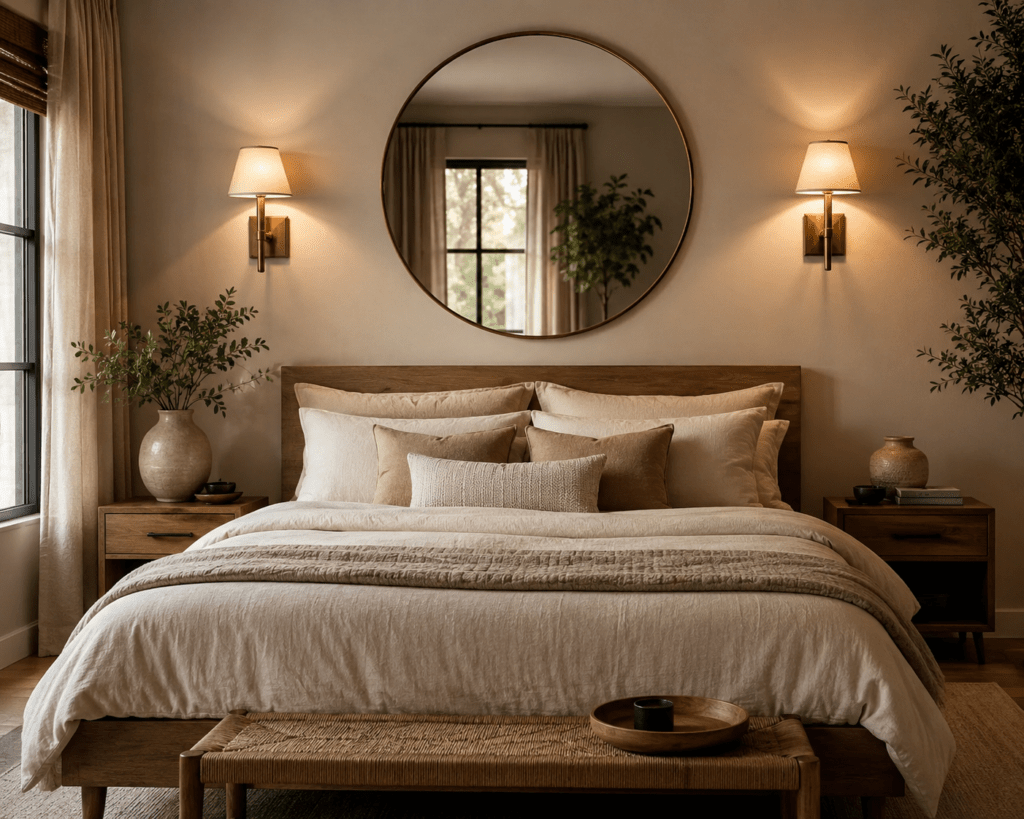
Art isn’t the only option — and sometimes it isn’t even the best one for your wall.
Statement Mirrors
IDEA: A large round, arched, or sunburst mirror above the bed instead of framed art.
WHY: Mirrors do double duty: they add visual interest and they bounce light around a room, which is especially useful in bedrooms with only one window.
HOW: Size and hang a mirror using the same width and height rules as art. If you’re concerned about feng shui guidance around mirrors facing the bed, position it slightly off-center or choose a smaller size as a compromise, or place it on an adjacent wall instead.
PRODUCT: An oversized sunburst mirror or a large arched mirror in a warm metal or wood-tone frame. Check the product on Amazon.
TIP: Confirm the wall anchor can support the mirror’s actual weight — mirrors are meaningfully heavier than a comparable canvas print, and this is one wall you really don’t want a hardware failure on.
Macramé and Woven Tapestries
IDEA: A large-scale textile piece instead of framed art.
WHY: Tapestries fill a lot of wall space for relatively low weight, which makes them a strong option for wide walls where a big framed piece would be expensive or heavy to hang safely.
HOW: Hang using a wood dowel and simple wall hooks rather than a frame — this is typically lighter-duty hardware than what a large framed piece needs.
PRODUCT: A large woven cotton or macramé wall hanging sized to your bed’s width range. Check the product on Amazon.
TIP: Tapestries add real texture but not much color — if your bedding and walls are already neutral, consider a tapestry with some pattern or color to avoid the whole wall reading as flat.
Floating Shelves and Ledges
IDEA: One or two floating shelves instead of (or combined with) wall art.
WHY: Shelves let you display and rotate smaller items — framed photos, small art, plants, books — without committing to one permanent piece. They also double as a spot for a reading lamp or your phone at night.
HOW: Mount shelves at or slightly below the height where you’d hang art, and style them with a mix of heights and a few negative-space gaps so they don’t look overstuffed.
PRODUCT: A pair of matching floating wood ledge shelves, mounted at slightly different heights above the headboard. Check the product on Amazon.
TIP: Don’t overload a ledge with heavy items directly above where someone’s head will be. Keep anything breakable or heavy toward the ends, not the center.
Wall Sconces and Layered Lighting
IDEA: Wall-mounted sconces flanking the bed, either alone or paired with art above.
WHY: Sconces free up nightstand space and add warm, layered light that overhead lighting can’t replicate — which matters a lot in a room whose entire job is to feel restful.
HOW: Mount sconces at roughly 60 to 66 inches from the floor, positioned symmetrically on either side of the headboard, low enough to comfortably reach a switch or pull cord from bed.
PRODUCT: A pair of plug-in wall sconces (no hardwiring required) in a finish that matches your other bedroom metal accents. Check the product on Amazon.
TIP: If you’re layering sconces with art or a mirror above, keep the art centered on the bed and let the sconces frame it symmetrically — that combination reads as designed, not accidental.
Wallpaper or an Accent Wall Behind the Bed
IDEA: Add a patterned or textured accent wall behind the bed, then layer art or a mirror on top of it.
WHY: An accent wall gives you a “free” focal point even before you add art, and it makes a small or plain piece of art look more intentional because it now has a backdrop instead of a bare wall.
HOW: Choose a peel-and-stick wallpaper if you’re renting, and keep the pattern scale in mind — a bold, large-scale print behind the bed can carry the whole room without needing much additional decor on top of it.
TIP: If you add wallpaper, size down your art slightly. A busy patterned wall plus an oversized statement piece can compete rather than complement.
Above Bed Wall Decor by Category: What to Shop For

Here’s a quick-reference roundup of the main product categories worth shopping, organized by what they’re best for.
| Category | Best For | Watch Out For |
|---|---|---|
| Canvas/framed art | Most bedrooms; safest all-around choice | Cheap frames can warp; check material description |
| Metal wall art | Modern, farmhouse, industrial styles | Confirm actual weight and wall anchor needs |
| Mirrors | Adding light, coastal/glam styles | Heavier than art; needs sturdy hardware |
| Macramé/tapestry | Boho styles, wide walls, low weight | Adds texture but limited color |
| Gallery wall frame sets | First-timers who want a built-in template | Confirm frame count matches your wall width goal |
| Wall sconces | Reading light, layered ambiance | Check plug-in vs. hardwired before buying |
| Floating shelves | Rotating decor, personal photos | Don’t overload directly above sleepers |
Buying Guide: What to Actually Check Before You Buy
Material. Canvas prints are lightweight and budget-friendly but can look flat up close. Framed prints under glass have more depth but add weight and cost. Metal and wood pieces bring texture but are usually heavier and need sturdier hardware.
Orientation. Horizontal pieces suit the wide, low wall space above most beds and echo the shape of the bed itself. Vertical pieces work better for narrower walls, taller headboards, or when you’re intentionally trying to draw the eye upward in a room with low ceilings.
Color match. Pull one or two colors from your existing bedding or curtains into the art, rather than trying to match everything exactly. An exact match can look flat; a shared accent color ties the room together without being matchy.
Weight and hardware. Before you buy, think about how you’ll actually hang it. A large framed piece or mirror needs real wall anchors, not just a nail — especially on a wall where the “target” underneath is someone sleeping.
Single piece vs. set. A single statement piece is the lower-effort, lower-risk choice, and it’s usually the safer pick if you’re not confident about spacing and layout. A set or gallery wall gives you more flexibility to mix styles but takes more planning to get the spacing right.
Common Mistakes to Avoid
- Going too small for the wall. This is the single most common issue — always size up when you’re unsure.
- Hanging too high or too low. Stick to the 6–10 inch gap above the headboard; don’t eyeball it from across the room.
- Ignoring your existing color palette. Bring a photo of your bedding or a paint swatch with you (or pull it up on your phone) when shopping so you’re not guessing at color match.
- Using flimsy hardware on heavy pieces. A sawtooth hanger is fine for a light print; it is not fine for a large mirror or a heavy framed piece.
- Overcrowding a gallery wall. Inconsistent spacing between frames is what makes a gallery wall look messy instead of curated — measure your gaps, don’t just eyeball them.
- Decorating for the room instead of the person sleeping in it. A guest room, a kid’s room, and a primary bedroom all call for different styles and different safety considerations (especially around weight and hardware).
FAQ
What size art should go above a bed? Aim for roughly two-thirds to three-quarters of your bed or headboard’s width. For a queen bed (about 60 inches wide), that puts you in the 39–45 inch range for total art width.
How high should you hang wall art above a bed? Leave a gap of about 6 to 10 inches between the top of the headboard and the bottom edge of the art. Without a headboard, center the piece around 57–60 inches from the floor.
What should I put above my bed instead of art? A large mirror, a woven tapestry, floating shelves, or a combination of wall sconces with a smaller accent piece all work well as alternatives to traditional framed art.
Is it OK to hang a mirror above a bed? Design-wise, yes — mirrors add light and work well above a bed. Some people avoid mirrors directly facing the bed for feng shui reasons; if that matters to you, offset the placement slightly or choose an adjacent wall instead.
Can I hang wall art above a bed without a headboard? Yes. Without a headboard as your reference point, center the art around 57–60 inches from the floor, which is the standard eye-level height used throughout most rooms in a home.
What’s the best above-bed decor for a small bedroom? A single, well-proportioned piece usually works better than a busy gallery wall in a small room — it creates a clear focal point without adding visual clutter to an already tight space.
How do I hang heavy art or a mirror safely above a bed? Use wall anchors rated for the actual weight of the piece, not just a nail, and confirm what’s behind your drywall (stud vs. hollow wall) before you commit to a hanging method.
Should above-bed art be horizontal or vertical? Horizontal generally suits the wide, low wall space above most beds and pairs naturally with the shape of the bed itself. Vertical can work well for narrower walls or when you want to draw the eye upward in a room with higher ceilings.
Conclusion
Above bed wall decor comes down to a simple formula once you break it apart: get the size right (two-thirds to three-quarters of your bed’s width), get the height right (6 to 10 inches above the headboard), then choose a style and material that actually fits how you use the room.
Everything else — whether that’s a canvas print, a statement mirror, a woven tapestry, or a mix of shelves and sconces — is really just personal taste layered on top of that foundation.
Start with the measurements, not the shopping. Once you know your target size and height, picking the right piece gets a lot easier, and the wall above your bed finally becomes the room’s focal point instead of its most avoided corner.
Visit the link for more ideas about Bedroom Wall Decor